Bible Study Guide for Beginners: How to Choose Yours
A good Bible study guide for beginners is short, clear, and kind. It explains the basics in plain words, takes about 15 minutes a session, works with any Bible, and does not guilt you for missing a day. Use the checklist below to compare guides before you spend money.
What does a good Bible study guide for beginners need?
A good beginner guide has five things. If a guide is missing most of them, keep looking.
- A clear structure. Each session tells you what to read, what to think about, and where to write. You should know what to do first without a tutorial.
- Honest time. Look for sessions of 15 to 20 minutes. A guide that needs 45 minutes a day is a weekend project, not a daily habit.
- Any translation. The guide should point to passages and ideas, not one version's exact wording.
- Basic context. It should say who wrote a passage, who it was for, and why it matters, in plain language.
- Room to miss days. Look for "go at your own pace" language and no rigid day-by-day schedule.
Nice extras include good questions and a clear path from week to week. Good questions make you think. "What did Jesus say in verse 4?" is a quiz. "Where in your life do you need this kind of patience?" is a question.
Why do so many guides feel overwhelming?
Many guides say "beginner" on the cover but assume you already know the Bible. They ask for long daily reading, cross-references to books you have not opened, and background you do not have yet.
If that sounds familiar, you are not the problem. The guide may be built for someone further along.
Red flags to watch for
These signs often mean a guide is not for beginners.
- Too much author, not enough Bible. If it is mostly stories and opinions, it is a devotional with study questions added. That is not wrong, but it is a different thing. See how a study guide differs from a devotional.
- Guilt as motivation. Any guide that shames you for missing days is a hard pass.
- Advanced terms in week one. Big technical words with no explanation are a sign it is not made for new readers.
- No application. A guide that never asks what the passage means for your life is incomplete.
- Looks over substance. Pretty design is fine. It should not be the main reason to buy.
What order should I study the Bible in?
Do not start at Genesis and read straight through. Many readers slow down or stop around Leviticus.
Many people start with a short, clear book instead.
- John introduces who Jesus is.
- Mark is short and fast-paced.
- Psalms is poetry that fits many moods.
- Proverbs is practical wisdom.
For a full breakdown, see the easiest book of the Bible to study first. A good guide will also tell you where to begin. If you want the basics of getting started, read how to start studying the Bible.
How can I try a guide before I commit?
Test a guide before you buy it. This takes a few minutes.
- Look at one session. Is it clear what you are supposed to do?
- Time yourself. Does it take as long as the guide claims?
- Read the questions. Do they make you think, or are they fill-in-the-blank?
- Read the introduction. Does the author explain the method, or assume you know it?
- Look at a later week. Is it still useful, or does it repeat itself?
If you can preview a sample page, do it. Check the return policy too, and read it before you pay.
A simple checklist for picking your first guide
Copy this list and check it off as you compare guides.
- Sessions take about 15 to 20 minutes
- It works with the Bible I already own
- It explains the basics in plain words
- It tells me where to start
- Missing a day does not put me behind
- The questions ask me to think, not just fill in blanks
- It asks what the passage means for my life
- I can preview a sample page
- The return policy is clear
Guides worth a look
Here are the guides and tools we have written about. Each review page has the details. We list them by type so you can find what fits you.
- Elvasma: a one-page-per-book overview guide.
- Valorrea: a 52-week themed guide.
- Spiral Bible: a spiral-bound note-taking Bible.
- She Reads Truth: a reading-plan app with printed study books.
- Hosanna Revival: hand-painted Bibles and journals.
- The Bible Recap: a free podcast and reading plan.
You can also see them side by side on our Bible study reviews page.
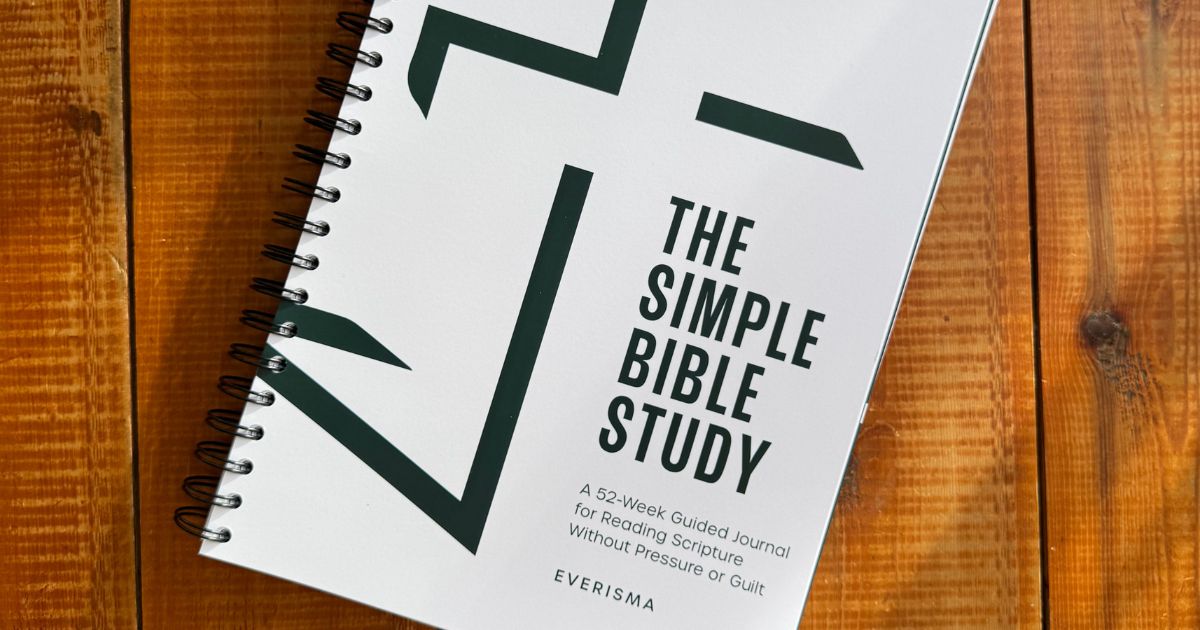
The Simple Bible Study is our own product, made by Everisma. It is a 52-week guide. Each week has a devotional, seven Scripture readings, three reflection questions, and a weekly blessing. It is undated, so you cannot fall behind, and it works with any translation. It costs $49 as of October 7, 2026, and has a 30-day money-back guarantee, so read the return terms first. You can look at it here.
Frequently asked questions
Do I need a specific Bible to get started?
No. Any Bible works. If you do not own one, a modern translation such as the NLT or NIV is easy to read. You can try other translations later.
How much time should a beginner spend on Bible study each day?
Start with 10 to 15 minutes. Showing up most days matters more than how long you stay. You can add time later if you want to.
What if I do not understand what I am reading?
That is normal. The Bible was written long ago in other cultures. A good guide gives context, and it is fine to look things up or mark a passage and come back to it later.
Can I study the Bible on my own, or do I need a group?
You can study on your own. Groups help with talking things over, but solo study is a valid way to start.
Is it too late to start studying the Bible as an adult?
No. There is no age limit and no prerequisite. Whenever you start is a fine time.
A Bible Study You Can't Fall Behind In
The Simple Bible Study is the guide I use. It is also our own product, made by Everisma. It has 52 weekly themes and no dates.
See The Simple Bible Study
Hi, I'm Kristen
I'm a coffee-loving mom of two. I quit more Bible studies than I finished. Then a 15-minute routine stuck. I write Bible Momma so you can stop feeling guilty and start again. Bible Momma is made by the team behind Everisma, and The Simple Bible Study is the guide I use.
More about me